

Eight score and two years ago, on November 19, 1863, Abraham Lincoln stood on a platform in Gettysburg, Pennsylvania and delivered what would become one of the most famous speeches in American history.
A few months before, Gettysburg had been the site of the bloodiest battle of the Civil War. Lincoln was there to dedicate a cemetery for the soldiers who had died in the battle. But he was also there to tell people their deaths should not happen in vain.

A war over slavery
The Battle of Gettysburg took place over three days in 1863 and was the bloodiest of the Civil War. By that point, the war had been going on two years between the Union (the northern states) and the Confederacy (the southern states, which had seceded from the United States with the idea of forming their own country).
“After decades and decades of compromises, primarily over the issue of slavery, there came a point where they could no longer find a compromise,” said Barbara Sanders, education specialist at Gettysburg National Military Park. “Either slavery was wrong, or it was OK.”
After the southern states seceded (say that three times fast), they formed the Confederate States of America in February 1861. Two months later, Confederate soldiers fired the first shots of the Civil War at Fort Sumter, South Carolina.
Most of the war was fought in Confederate territory, and up until Gettysburg, was going well for the South. So the Confederate soldiers, led by General Robert E. Lee, crossed the Mason-Dixon Line, which separated where slavery was legal and where it was illegal. That line separates Pennsylvania and Delaware in the North and Maryland and West Virginia in the South.
Three bloody days
The battle began on July 1, 1863 with a Confederate victory, forcing the Union Army to retreat through the town to high ground called Cemetery Hill.
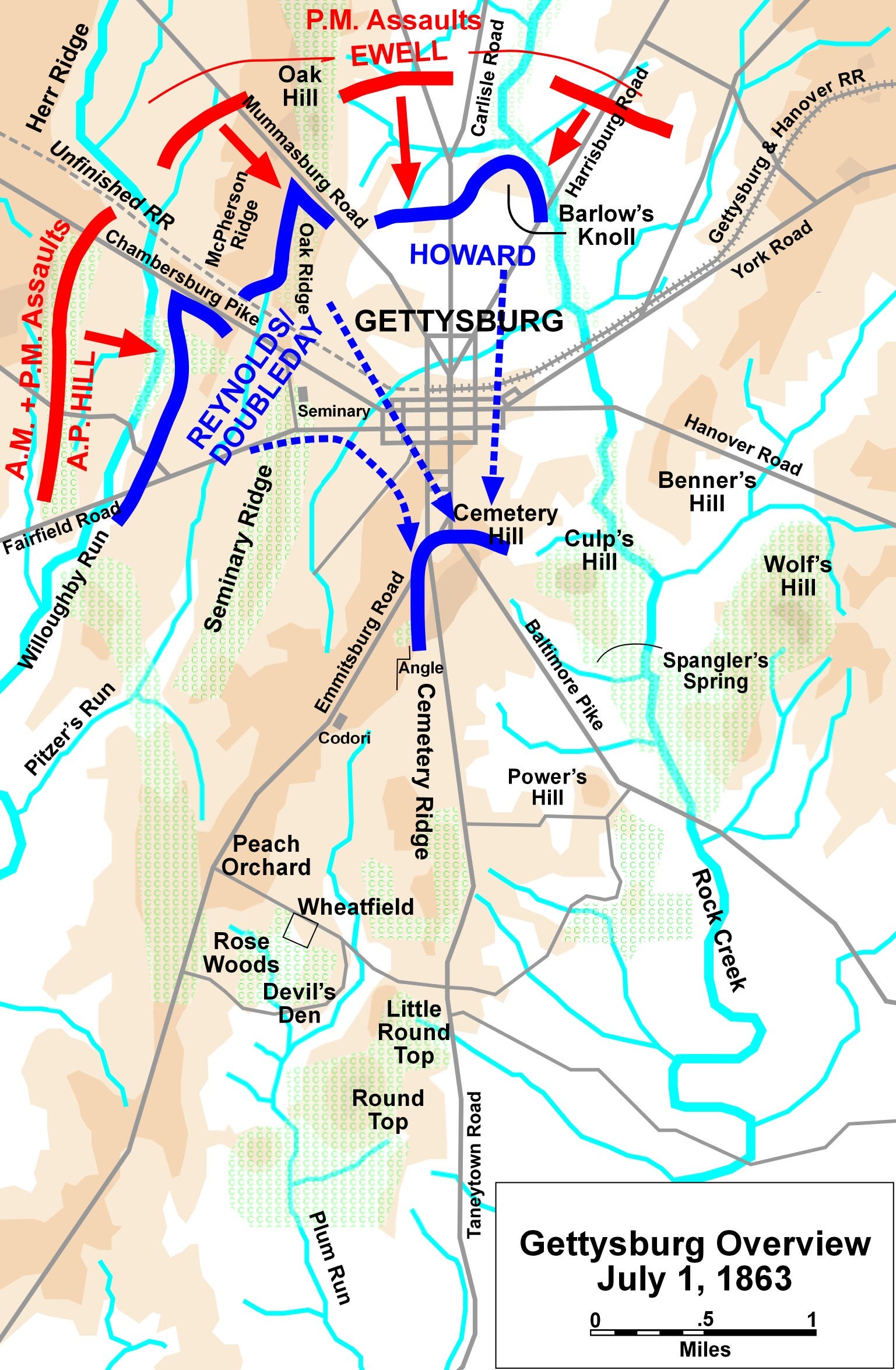

“You wanted the high ground in the Civil War. As more Union troops were coming, they began creating a line where, if you were a bird flying over, looked like a fish hook,” Sanders said. “As the Confederates are coming, now they’re going to be in a position where they have to attack, and the Union Army is going to have a good defensive position.”
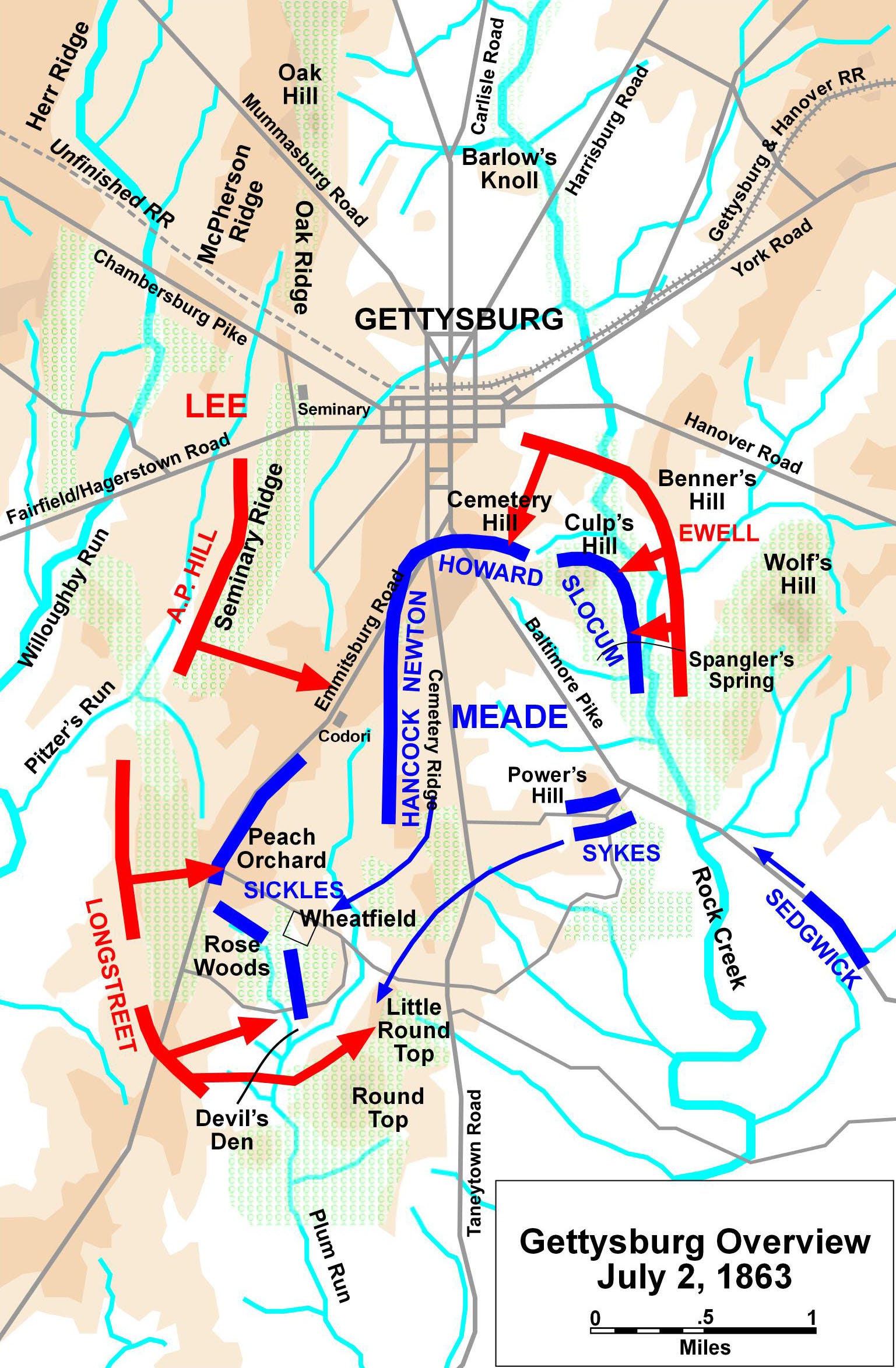
On the second day, Confederates attacked the ends of the line but were unable to break through.
“Nobody really won the second day,” Sanders said.

On the third day, however, the Confederates tried to break through the center of the Union line, hoping it would be a weak spot. In an action called Pickett’s Charge, they fired over 100 cannon shots and followed with an infantry assault of 13,000 soldiers, Sanders said.
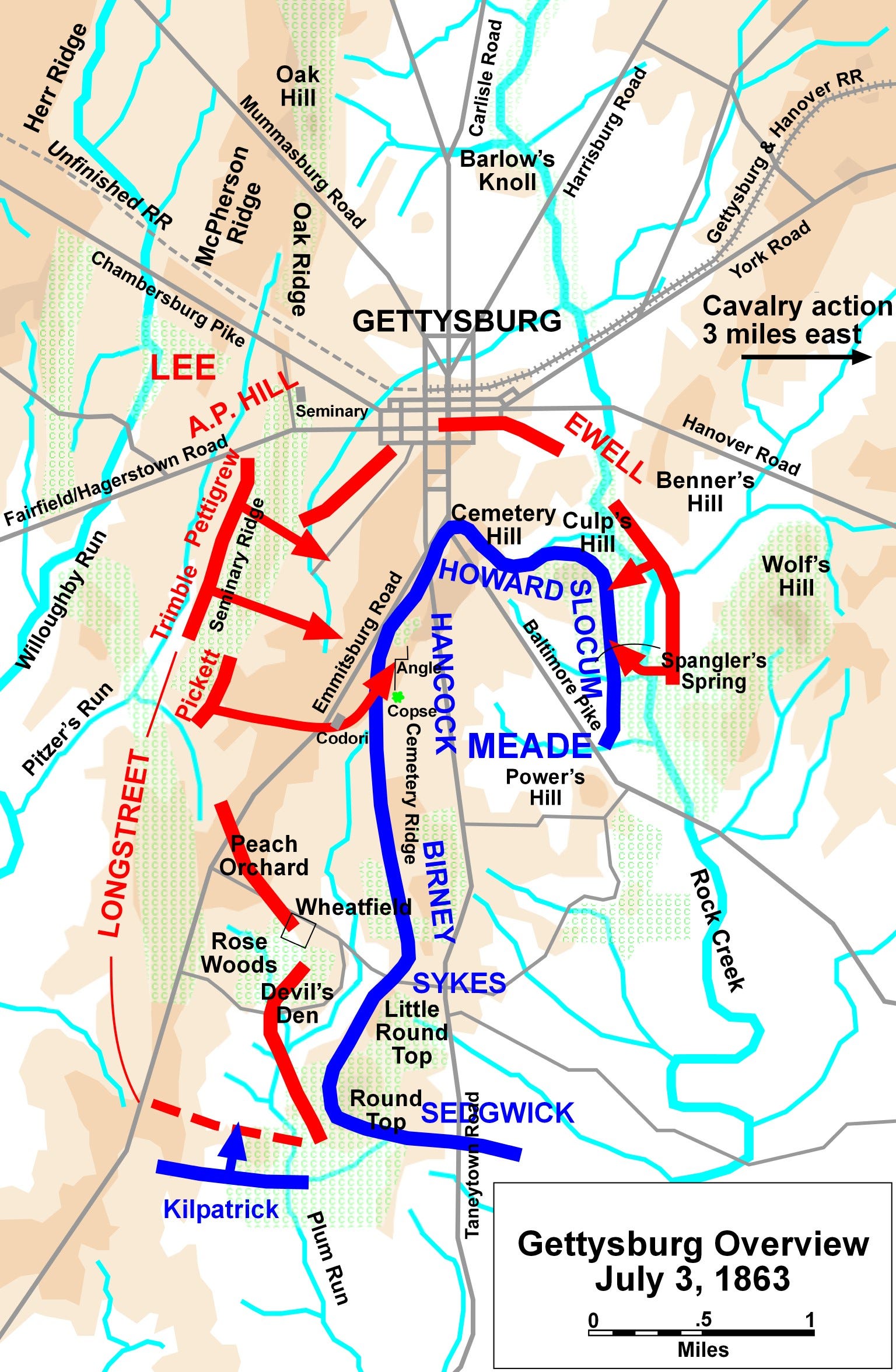

“A couple hundred [troops] did break through, but not enough, and Union reinforcements repelled that assault,” Sanders said.
The Confederate soldiers retreated, and the Battle of Gettysburg was over.
“It was a Confederate defeat,” she said.
The Gettysburg Address
Sanders said many visitors to Gettysburg believe the battle there was the end of the war, but it wasn’t.
“The war is going to go on for almost two more years, but never again will the Confederate Army come this far north,” she said.
The battle made the Union believe not only that they could win the war, but they must.
“I think Gettysburg was a turning point not just because of the victory of the Army but also because of President Lincoln coming here in November of 1863 to deliver his Gettysburg Address,” she said.

By this time, people were tired of the war and unhappy with Lincoln that it was still going on.
“President Lincoln wasn’t popular the way we remember him at the time,” she said. “People in the North now saw what war and battle was like, and there was a growing movement…of people who were saying, ‘Let’s just end the war. Let’s just split into two countries, and as each country expands west, they can decide what to do about that institution of slavery.’”
Lincoln went to Gettysburg to make the case that the war must go on, and must be a Union victory.
“The world will little note, nor long remember what we say here,” Lincoln said in his speech, “but it can never forget what they did here.”
In order to make the deaths of the Union soldiers meaningful, the Union had to keep going to win the war and prove a nation “of the people, by the people and for the people” could endure.
The speech was not well received at first. In fact, the Patriot & Union, a local newspaper, published a scathing editorial criticizing the speech.
It read: “We pass over the silly remarks of the President. For the credit of the nation we are willing that the veil of oblivion shall be dropped over them and that they shall be no more repeated or thought of.”
However, 150 years later, the same newspaper, known today as the Patriot-News, apologized for its remarks and retracted them.
Below is the speech in its entirety.
Four score and seven years ago our fathers brought forth on this continent, a new nation, conceived in Liberty, and dedicated to the proposition that all men are created equal.
Now we are engaged in a great civil war, testing whether that nation, or any nation so conceived and so dedicated, can long endure. We are met on a great battle-field of that war. We have come to dedicate a portion of that field, as a final resting place for those who here gave their lives that that nation might live. It is altogether fitting and proper that we should do this.
But, in a larger sense, we can not dedicate—we can not consecrate—we can not hallow—this ground. The brave men, living and dead, who struggled here, have consecrated it, far above our poor power to add or detract. The world will little note, nor long remember what we say here, but it can never forget what they did here. It is for us the living, rather, to be dedicated here to the unfinished work which they who fought here have thus far so nobly advanced. It is rather for us to be here dedicated to the great task remaining before us—that from these honored dead we take increased devotion to that cause for which they gave the last full measure of devotion—that we here highly resolve that these dead shall not have died in vain—that this nation, under God, shall have a new birth of freedom—and that government of the people, by the people, for the people, shall not perish from the earth.